
Every business has a budget. There is nothing wrong with looking for value, comparing quotes, or starting small. The problem begins when the cheapest website is treated as automatically being the least expensive website.
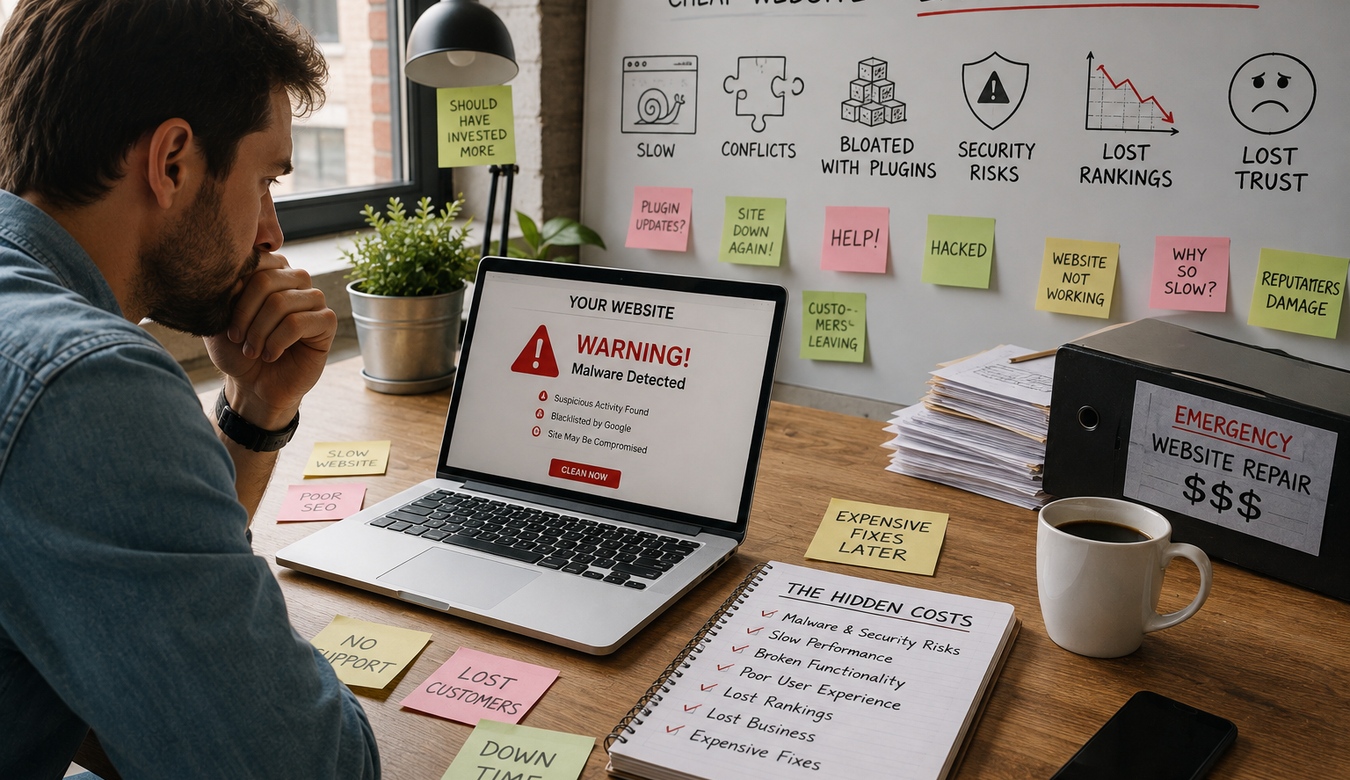
A site can cost very little to launch and become surprisingly expensive to own. The extra cost may arrive as slow performance, broken features, plugin subscriptions, emergency repairs, malware cleanup, poor search visibility, missed enquiries, or hours spent trying to understand why something that worked last month no longer works today.
The price on the proposal is only the beginning. What matters is what the website costs the business over its useful life.
1. Cheap and Good Value Are Not the Same Thing
A simple website does not need to be expensive. If a business needs five clean pages, clear contact information, good mobile design, and dependable hosting, there is no reason to turn it into an enormous development project.
Good value means paying for what you actually need and having it built properly. Cheap becomes a problem when the low price is achieved by skipping planning, using poor-quality components, ignoring security, stacking unnecessary plugins, or leaving nobody responsible for the site after launch.
Look beyond launch day. Consider reliability, maintenance, performance, security, support, and how easily the site can grow with the business.
2. Plugin Bloat Has a Price
WordPress plugins are incredibly useful. The problem is using a plugin for every tiny requirement without considering what each one adds to the system.
A cheaply assembled site may rely on overlapping page builders, multiple add-on packs, several optimization tools, abandoned plugins, and a collection of extensions installed because they solved one small problem at the time.
Eventually, nobody remembers why half of them are there. Updates become risky. Conflicts appear. The dashboard slows down. Some plugins require annual licences. Others inject scripts into every page whether they are needed or not.
A well-planned website tries to solve the requirement with the cleanest reasonable architecture — not the largest plugin collection.
3. A Slow Website Costs More Than Patience
Performance problems affect the experience customers have with the business. If pages hesitate, images jump around, mobile navigation struggles, or checkout feels sluggish, visitors do not care which plugin caused it. They simply experience a slow company website.
Speed can also affect marketing and search performance. Paying to send advertising traffic to a frustrating landing page is a particularly painful way to discover that inexpensive development had a hidden cost.
Performance should be considered while the site is being built, not only after it becomes a problem.
4. Security Shortcuts Can Become Emergency Bills
Security is one of the areas where shortcuts may remain invisible for months. Old software, weak administrator practices, abandoned plugins, poor hosting, missing backups, and careless server configuration can quietly increase risk.
Then one day the site redirects visitors, sends spam, displays unfamiliar content, gets blocked by a browser, or simply stops working.
Cleaning a compromised WordPress installation can require investigation, file cleanup, database review, password resets, software updates, server hardening, monitoring, and sometimes rebuilding portions of the site.
Preventive care is generally much less disruptive than emergency recovery.
5. A Website Can Look Fine and Still Be Poorly Built for Search
A cheap site may technically have all the pages requested while missing the structure that helps search engines and visitors understand them.
Weak headings, duplicate page titles, oversized images, poor internal linking, missing metadata, broken mobile layouts, confusing URLs, and slow performance can all reduce the value of the finished site.
SEO is not a magic switch installed after launch. A good technical and content foundation makes future search work much easier.
6. The Biggest Hidden Cost May Be the Customer Who Never Calls
This is the cost that never appears on a hosting invoice.
A visitor lands on the website. It looks dated. The page is slow. The contact form feels questionable. The mobile layout is awkward. The business information is hard to find. They press Back and call somebody else.
You may never know that enquiry existed.
A professional website cannot guarantee a sale, but it should remove unnecessary reasons for a potential customer to lose confidence.
7. Know What You Actually Own
Low-cost website packages sometimes become complicated when the business tries to move. Who owns the domain? Where is the site hosted? Do you have administrator access? Are premium plugins licensed to your business or only to the developer? Can the site be migrated? Do you have a backup?
These are boring questions until you need the answers.
A business should understand where its digital assets live and how it can access them.
8. Rebuilding Someone Else's Shortcuts Takes Time
One of the frustrating realities of web development is that fixing a poorly assembled website can take longer than building the feature correctly in the first place.
Before changing anything, a developer may need to understand custom code, theme overrides, plugin dependencies, old CSS, hosting restrictions, and undocumented decisions made years earlier.
This does not mean every old website should be thrown away. Often it can be improved. But technical debt is real, and businesses eventually pay for it in maintenance time.
9. What Happens After the Website Launches?
A website should not become an orphan the moment the final invoice is paid. Someone needs to know how updates, backups, hosting, security, content changes, and technical problems will be handled.
Support has value because websites exist in a changing environment. A good relationship with a developer or website-care provider means there is somebody to call when something unusual happens.
That can be worth far more than saving a small amount at the beginning and having no idea who to contact six months later.
10. What If Your Budget Really Is Small?
Then be honest about it. A professional developer should be able to help prioritize.
Maybe phase one needs fewer pages. Maybe a complicated feature can wait. Maybe you start with a clean, fast informational site and add ecommerce later. Maybe an existing site can be improved instead of replaced.
A smaller website built on a solid foundation is often a better investment than a huge list of features assembled as cheaply as possible.
Budget should shape the scope — it does not have to destroy the quality.
11. Ask Better Questions Before Choosing a Website
Do not compare quotes only by the number at the bottom. Ask what is included. Ask about mobile design, backups, hosting, security, performance, licences, support, ownership, updates, and what happens if the site needs to grow.
Ask whether the person building it will still be available after launch.
Most importantly, ask whether the proposed website actually supports what your business is trying to accomplish.
12. How ANJ Design Can Help
If you are comparing website options, dealing with a site that has become expensive to maintain, or wondering whether an existing website is worth repairing, ANJ Design can help you look at the bigger picture.
We can review the design, WordPress setup, plugins, hosting, performance, security, backups, mobile experience, and overall condition of the site. Sometimes the answer is a redesign. Sometimes it is a cleanup. Sometimes the smartest decision is to keep what is working and fix only the parts causing trouble.
You do not need to arrive knowing the technical solution. Call us or send us an email. Tell us what the website is doing, what is frustrating you, and what you need the business to accomplish. We're here to help.
13. Buy the Website Your Business Can Depend On
A professional website does not have to be extravagant. It needs to be appropriate, dependable, maintainable, secure, fast enough for its audience, and designed around the business it represents.
The goal is not to spend the most money. The goal is to avoid paying repeatedly for the same problems.
If a cheap website works well and meets the business need, wonderful — that is genuine value. But if the low price is hiding poor architecture, weak support, security risks, and constant repairs, the bargain disappears quickly.
Before you choose based only on price, give us a call or send us an email. A short conversation now may save a much more expensive conversation later.
Call or email ANJ Design. We can review what you have, explain where the real problems are, and help you decide whether to repair, improve, or rebuild — without the technical sales pitch.