If you have ever owned a WordPress website, somebody has probably asked, “What theme are you using?” It sounds simple, but a theme is one of the most misunderstood parts of WordPress.
It is easy to think of a theme as a coat of paint: choose a design, change the logo, pick some colours, and the website is finished. In reality, a theme can influence layout, templates, typography, navigation, responsive behaviour, content presentation, and how easily the site can evolve.
So when should you use an existing theme, and when is it worth building something custom? The answer depends much more on the business than on what happens to be fashionable in WordPress this year.
1. What Does a WordPress Theme Actually Do?
WordPress manages content. The theme helps determine how that content is presented to visitors. It can provide templates for pages, blog posts, archives, headers, footers, search results, and other parts of the site.
Modern themes may also include design settings, block patterns, template parts, custom styling, and integrations with page builders or plugins.
A good theme should support the website's purpose instead of forcing the business to squeeze itself into a demo layout.
2. Theme or Plugin? They Have Different Jobs
A useful rule is that the theme generally controls presentation while plugins add functionality. A contact form, ecommerce system, membership feature, SEO tool, or booking engine usually belongs in plugin territory.
Keeping those responsibilities reasonably separated matters. If changing the visual theme suddenly removes important business data or functionality, the website can become unnecessarily difficult to maintain.
There are exceptions, but good architecture tries not to lock essential business features inside a design that may eventually change.
3. There Is Nothing Wrong With a Good Ready-Made Theme
Custom is not automatically better.
For many businesses, a well-supported existing theme can be an excellent starting point. It may already handle accessibility, responsive layouts, browser compatibility, common WordPress features, and useful design controls.
If the project is relatively straightforward and the theme closely matches what the business needs, starting there can save development time and budget.
The important part is choosing the theme because it fits the project — not choosing the project because it fits the theme.
4. Be Careful With the Beautiful Demo
Theme demos are designed to sell themes. They often use exceptional photography, perfectly sized headlines, carefully curated content, and every visual feature in its best possible setting.
Then the real business content arrives. The headline is twice as long. There are no cinematic photographs. One service needs a complicated explanation. The team has seven people instead of three.
A theme should be evaluated with your content and requirements in mind, not only by how impressive its demo looks.
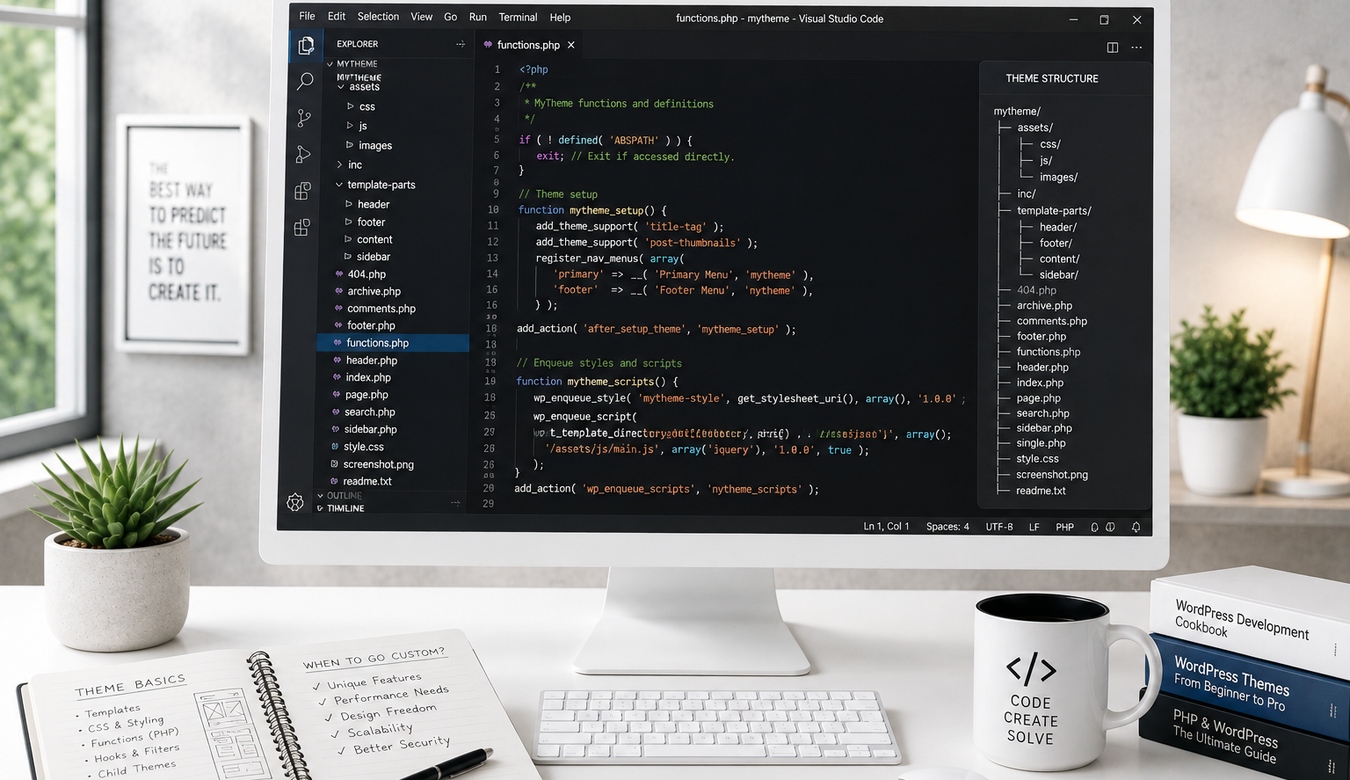
5. What Is a Custom WordPress Theme?
A custom theme is designed and developed specifically around a particular website or organization rather than beginning with a general-purpose commercial design.
That may include custom templates, components, styling, responsive behaviour, content structures, and integrations created around the site's actual requirements.
Custom does not necessarily mean reinventing every technical wheel. WordPress itself provides established systems and standards. The value is in creating the presentation and architecture the project needs without carrying an entire catalogue of features it does not.
6. When Does Custom Start to Make Sense?
Custom development becomes attractive when the website has a strong visual identity, unusual content requirements, specialized workflows, or layouts that would require fighting a pre-built theme at every turn.
It can also make sense when performance and maintainability are priorities, when the site needs repeatable custom components, or when a business wants tighter control over how editors create content.
If you are spending more time overriding a theme than benefiting from it, the “shortcut” may no longer be much of a shortcut.
7. Custom Design Can Make the Brand Feel Like Itself
One challenge with popular themes is familiarity. Thousands of websites may share the same layout patterns, spacing, card styles, and navigation behaviour.
That is not inherently bad, but a business with a distinctive brand may want more freedom.
A custom theme can let the visual identity influence the website from the beginning — typography, imagery, colour, motion, spacing, content rhythm, and interactions can all be designed as one system.
8. Custom Can Be Leaner — If It Is Built Well
Large multipurpose themes are designed to serve many kinds of websites. That flexibility can mean options and code your particular site never uses.
A focused custom theme can include only what the project needs, which may make performance and maintenance easier to control.
But custom code is not automatically fast code. Poor custom development can be worse than a well-engineered commercial theme. The quality of the implementation matters more than the label.
9. What About Elementor and Other Page Builders?
Page builders can be extremely useful. They give editors visual control, speed up certain types of page creation, and can reduce the amount of custom development required.
They can also be combined with custom theme work. This does not have to be an either-or decision.
The right question is how much flexibility the people maintaining the site need and where design consistency should be protected. A good setup gives editors freedom without requiring them to redesign the entire website every time they add a page.
10. Sometimes a Child Theme Is the Middle Ground
If an existing theme is fundamentally right but needs safe customization, a child theme can provide a place for modifications without directly editing the parent theme's files.
This can be a practical approach for CSS changes, template adjustments, and selected custom functionality while still benefiting from updates to the original theme.
It is one more reason the answer is not simply “custom or not custom.” WordPress offers several levels of customization.
11. Think About the Person Maintaining the Site Two Years From Now
A website should not only be easy to launch. It should be understandable later.
Whether the theme is commercial or custom, consider documentation, updates, code quality, plugin dependencies, editor experience, backups, and how another developer could take over if necessary.
Clever code that nobody can maintain is not a business advantage.
12. How Do You Choose?
Start with the business requirement, not the technology.
What does the site need to do? How unique is the visual design? Who will edit it? How often will content change? Does it need ecommerce, memberships, directories, forms, or integrations? How important is future expansion? What budget and timeline are realistic?
Once those questions are clear, choosing between an existing theme, a customized theme, a child theme, or a fully custom build becomes much easier.
13. How ANJ Design Can Help
If you are planning a WordPress site and do not know whether you need custom development, that is completely fine. You should not have to decide the technical architecture before talking to the person building it.
ANJ Design can review the project, your brand, required features, editing needs, performance goals, hosting, and budget, then recommend an approach that makes sense.
Sometimes that will be a carefully selected existing theme. Sometimes it will be a customized framework. Sometimes the requirements genuinely justify a custom WordPress theme.
Call us or send us an email. Tell us what you want the website to accomplish. We'll help work out the best way to build it. We're here to help.
14. The Best Theme Is the One That Fits the Business
Customers do not care whether your theme came from a marketplace or was written specifically for you. They care that the website is fast, clear, professional, trustworthy, and easy to use.
The technology should serve that experience.
Do not pay for custom development simply because “custom” sounds premium. And do not force a complex business into a generic theme simply because it looks cheaper on day one.
If you are unsure which direction makes sense, call or email ANJ Design. We can look at the project with you before you make the decision.
Maybe. Maybe not. Call or email ANJ Design and tell us what you are trying to build. We'll help you choose the approach that fits the business rather than selling you complexity you do not need.